
Exporters on Thursday demanded fiscal incentives, tweaking in customs duties on certain products and credit at affordable rates in the forthcoming Budget to boost exports and create jobs. In a pre-budget virtual meeting with Finance Minister Nirmala Sitharaman, the Federation of Indian Export Organisations (FIEO) said the depreciation of the rupee against the US dollar is affecting exports' competitiveness and the sector requires more support. "Creation of employment is the biggest challenge faced by the country...We would urge the government to provide fiscal support to units which provide additional employment in the export sector," the exporter's body said.

Currently, banks follow system of internal benchmarks, including Prime Lending Rate, Benchmark Prime Lending Rate, Base rate and Marginal Cost of Funds based Lending Rate.
Rs 5,000 crore additional liquidity facility to be provided by the National Housing Bank to boost liquidity in housing sector, the RBI said.

Krishnamurthy Subramanian listed land, labour, law, and liquidity as the key areas of big reforms.

After the Insolvency and Bankruptcy Code came into force, which calls for an auction of assets of loan defaulting entities, recoveries have picked up, said Jaitley.

The protocol aims to "democratise" lending, reduce costs of credit, and ensure accessibility of credit to small companies and street vendors, according to Nandan Nilekani.

Bank credit growth declined to 8.5 per cent in January from 13.5 per cent in the year-ago period.

'Today, bankers don't want to take risks as the good decisions taken by them were not protected.' 'There is risk involved in all decisions, like businessmen taking risks in their businesses.' 'A banker must have taken a decision when the economic condition was different, and you cannot question him on the basis of the present situation in hindsight.' 'Naturally, this has affected the morale of bankers.'

The NDA government will be following the footsteps of its predecessor, the UPA, which had introduced the concept of "loan mela" to boost credit by directing banks to lend to people through public meetings.

After the finance minister directed public sector banks to join the account aggregator (AA) ecosystem, 5-6 major ones, including State Bank of India (SBI) and Bank of Baroda are expected to go live by July-end. Sahmati, an industry alliance for the AA ecosystem, has been working with PSU banks to get them onboarded for quite some time now. So far, Union Bank of India and Punjab National Bank (PNB) have gone live on the AA ecosystem. While Union Bank has been live for a while, PNB went live earlier this month.

The central bank tweaked the retail inflation range to 4.8-4.9 per cent in the first half of 2018-19, and 4.7 per cent in the second half.

Exports of petroleum products, chemicals, pharmaceuticals, gems and jewellery, and engineering goods registered a positive growth.

India Inc on Thursday pitched for continuation of reforms while ensuring tax and policy stability in the forthcoming Budget to prop up the economy hit hard by the COVID-19 pandemic. In the virtual pre-Budget consultation held with Finance Minister Nirmala Sitharaman, industry chambers said that government measures will help firmly entrench the nascent signs of recovery being currently seen in private investment. Capital expenditure by the government through enhanced infrastructure spending should in the meantime continue to support growth, CII president TV Narendran said.

'Our government has created 10 million jobs when the Indian unemployment rate is at a 45-year high.'

The Nifty Bank index has come off 15 per cent from its peak in February, underperforming the benchmark Nifty which is down 6%.

'Nobody is talking about the inequality that is going to come.'

'Where will industry have funds when they open up?'

India Inc on Tuesday expressed disappointment over the Reserve Bank increasing the key rate by 0.25 per cent and hoped that banks would refrain from hiking lending rates as such a move will scuttle economic recovery.

The RBI has this year cut interest rates by 110 basis points in four instalments but banks have passed only a part of it to borrowers. Before the last reduction earlier this month of 35 basis points, the bank on an average had passed only 29 basis points out of 75 basis points cut affected during 2019.

Fitch Ratings on Wednesday cut India's growth forecast to 10 per cent for the current fiscal, from 12.8 per cent estimated earlier, due to slowing recovery post second wave of COVID-19, and said rapid vaccination could support a sustainable revival in business and consumer confidence. In a report, the global rating agency said the challenges for banking sector posed by the coronavirus pandemic have increased due to a virulent second wave in the first quarter of the financial year ending March 2022 (FY22). "Fitch Ratings revised down India's real GDP for FY22 by 280bp to 10 per cent, underlining our belief that renewed restrictions have slowed recovery efforts and left banks with a moderately worse outlook for business and revenue generation in FY22," it said. Fitch believes that rapid vaccination could support a sustainable revival in business and consumer confidence; however, without it, economic recovery would remain vulnerable to further waves and lockdowns.

In an affidavit filed by Union finance ministry on behalf of the Union of India, it said that the relief to all borrowers in respect of compounding of interest during the period of moratorium would be admissible to the categories specified irrespective of whether the borrowers had availed the moratorium or not.

Experts attribute the lower target to increased allocation under the credit guarantee scheme for small businesses. Out of the Rs 3.21 trillion worth loans sanctioned under the Pradhan Mantri Mudra Yojana (PMMY) in the last financial year, Rs 3.12 trillion were disbursed to entrepreneurs, according to official data.

RBI Governor Raghuram Rajan on Tuesday said the Finance Ministry's decision to provide more capital to PSU banks will lower the borrowing cost and increase their capacity to lend, besides promoting investments.

The Supreme Court has refused to interfere with the government and RBI's loan moratorium policy, and declined to extend the six-month loan moratorium period.

PSB chiefs tried to argue that liquidity is in surplus in the system and the problem was related to lack of demand in the economy, instead of banks' reluctance to lend, but 'the FM said it is a perception issue that loan is not available, which we need to dispel,', reports Somesh Jha.

Modi, after delivering his sixth straight address to the nation on Independence Day from the ramparts of the Red Fort in New Delhi, went into a brainstorming session with Sitharaman and all top officials in her ministry, sources privy to the development said. T

SBI was the top gainer in the Sensex pack, rallying over 10 per cent, followed by Kotak Bank, Dr Reddy's, UltraTech Cement, ITC and HDFC Bank. On the other hand, Axis Bank, Bharti Airtel, ICICI Bank, Maruti and HCL Tech were among the laggards.

'It was like a doctor giving some simple pain killers to a patient in dire requirement of chemotherapy.' 'There was no sense of urgency or desperation in this particular Budget.'

Enthused by India's financial inclusion drive, US-based Accion, one of the biggest micro finance organisations in the world, has renewed its focus in India. Michael Schlein, bottom, left, chief executive officer of Accicon, tells Namrata Acharya in an email interview the Wall Street and Silicon Valley are eager to participate in opportunities presented by the issuance of the small finance and payment bank licences, the expanded banking correspondent opportunities, and the Jan-Dhan Yojna.

The major beneficiaries of loan recasting will be sub-Rs 500 crore corporate exposures and retail exposures, which were earlier expected to see the highest increase in NPAs in percentage terms.

'The worst is over, but it may take a couple more years for the banking system to re-establish the growth process.' 'Banks are the major pillars in an economy's revival.' 'Without banking operations and lending, revival will not happen.'

What will be its impact on the banks's balance sheets? Since banks need to provide for 10 per cent of the loans restructured, they would need Rs 50,000 crores to Rs 80,000 crore for this purpose, notes Tamal Bandyopadhyay.

Chief Economic Adviser K V Subramanian on Monday said the overall impact of the second wave of COVID-19 on the country's economy is not likely to be large but cautioned about an uncertainty surrounding the pandemic going ahead. He further said that given the circumstances due to the pandemic, it is difficult to forecast if the country would achieve a double digit growth in the current fiscal. The Economic Survey 2020-21 released in January this year had projected GDP growth of 11 per cent during the current financial year ending March 2022.

The government's Rs 20.97 lakh crore COVID-19 package lacks in addressing the immediate concerns of the economy as the actual fiscal impact of the additional stimulus is only about 1 per cent of the GDP as opposed to the claim of 10 per cent, Fitch Solutions said on Tuesday. Prime Minister Narendra Modi on May 12 announced a stimulus package of Rs 20 lakh crore, or nearly 10 per cent of GDP, to deal with the economic fallout of COVID-19. The contents of the package were broad-based and announced in five tranches.

Stressed MSME borrowers would be eligible for restructuring of debt, if their accounts were classified standard.

The evolving RBI-government relationship, a reversal in the interest rate cycle and return to profitability will dominate bankers' conversation this year, says Tamal Bandyopadhyay.

Indian economy was growing faster than the global average and all other major economies: FM
According to a communication by the ministry to the heads of PSBs, it will be a bottom-up consultative process from the branch level onwards which will involve discussions at the branch or regional level, state level and national level.
Linking all new floating rate loans to an external benchmark won't impact existing borrowers, so customers who have taken long-term home loans recently should watch things carefully, say Joydeep Ghosh and Sanjay Kumar Singh.
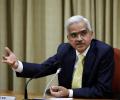
The Reserve Bank of India (RBI) on Friday decided to leave the benchmark interest rate unchanged at 4 per cent but maintained an accommodative stance, implying rate cuts in the future if need arises to support the economy hit by the Covid-19 pandemic.
